By Marcus T. · Updated 2026-08-20 · 12 min read
IPTV works by delivering television programming over the same internet protocol network your devices use to browse the web. Instead of receiving signals through a cable line, satellite dish, or antenna, your IPTV app or set-top box receives a continuous stream of video data from a remote server. That server encodes live channels and on-demand content into packets, sends them across your broadband connection, and your device decodes them back into watchable video in near real time. The diagram above shows this basic path: content source → hosting server → internet → your device → screen.
This is not a loosely defined “streaming service” in the Netflix sense, although there is overlap. IPTV can be a managed service delivered by a telecom provider, or a subscription service accessed through a third-party app. What makes it IPTV is the use of internet protocol as the transport layer for live TV, rather than a broadcast or coax infrastructure. You still get channel lineups, electronic program guides, and live sports, but the delivery method is entirely different from traditional cable.
Understanding that distinction matters because it changes what you need to make IPTV work well. You need a stable internet connection, a compatible app or device, and a subscription from a provider that operates servers close enough to your region to avoid latency. The rest of this guide explains each of those pieces, including how to set up IPTV on a smart TV or Firestick, what to watch for when buying a subscription, and how to fix the most common buffering problems.
What Is IPTV, Exactly?
IPTV stands for Internet Protocol Television. In practice, it means watching live broadcast channels through a dedicated app, player, or set-top box that connects to a provider’s server over your home internet connection. The content can include live TV, video-on-demand, catch-up TV, and even time-shifted playback. Unlike downloading a file, IPTV streams continuously, so you don’t store the full broadcast on your device.
There are three main types of IPTV delivery:
- Live IPTV — real-time broadcast of linear TV channels, often with a slight delay due to encoding and network travel.
- Video on Demand (VOD) — a library of movies and series you can start, pause, and resume at any time.
- Time-shifted TV — catch-up services that let you watch a show that aired hours or days earlier without recording it yourself.
Most modern IPTV platforms combine all three. The interface looks much like a cable or satellite guide, but everything arrives through your router. Some services use dedicated IPTV boxes with their own remote, while others run as apps on Android TV, Amazon Firestick, Apple TV, iOS, Android, and smart TVs from Samsung and LG.
One common point of confusion is how IPTV differs from OTT services like Netflix, YouTube TV, or Hulu. OTT means “over-the-top” and refers to any content delivered over the public internet without a traditional distributor. IPTV can be considered a subset of OTT when it uses the public internet, but the term IPTV more often implies a closer relationship to traditional broadcast TV — with live channel lineups, EPG data, and a subscription tied to a provider rather than a single app store.
How IPTV Works: Step-by-Step
Here is the technical flow behind a typical IPTV stream. Understanding these steps helps you troubleshoot and choose better providers.
- Content acquisition. The IPTV provider obtains channel feeds from satellite downlinks, broadcast networks, or licensing agreements. These raw feeds must be legally acquired if the service is legitimate.
- Encoding and compression. The video signal is converted into a digital format using codecs such as H.264 or H.265. Compression reduces the bandwidth needed while maintaining acceptable picture quality.
- Server distribution. Compressed streams are uploaded to high-capacity servers, often distributed across multiple data centers. A content delivery network (CDN) may be used to reduce latency for users in different regions.
- Authentication and authorization. When you log in via an app or portal, the middleware verifies your username, password, or playlist URL. Your account is checked for active subscription status and allowed channel groups.
- Stream request. Your device sends a request to the server for a specific channel or VOD title. The server responds with a continuous data stream containing small packets of video and audio.
- Decoding and playback. Your device’s player decodes the incoming packets and displays them on screen. A small buffer smooths out minor network jitter so playback does not stutter.
- Electronic program guide (EPG). Metadata for channel schedules is pulled from the provider. This lets you browse what’s on now and later, just like a traditional TV guide.
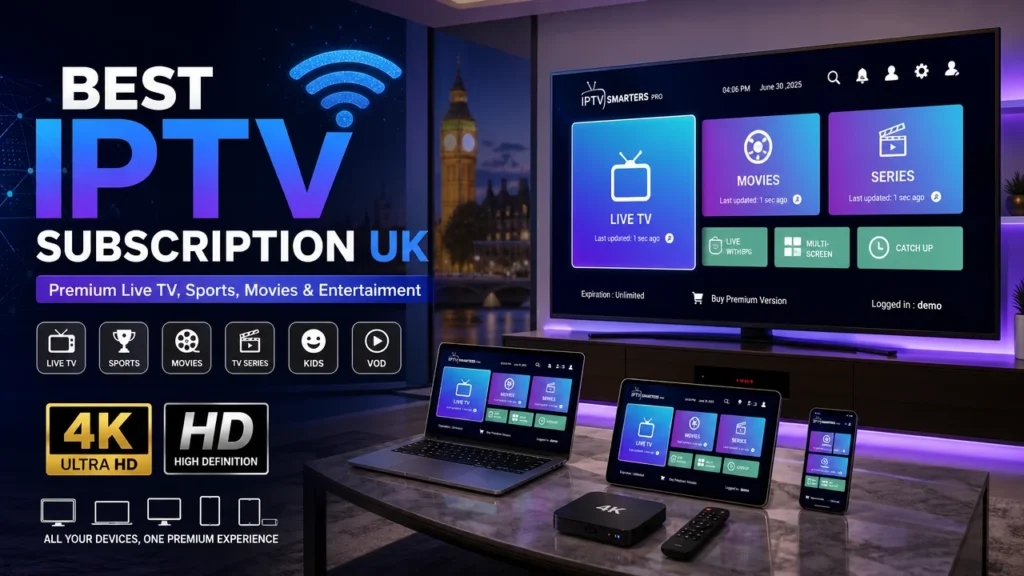
When you ask “how does IPTV work on smart TV,” the answer is essentially the same as above — the smart TV runs an IPTV app that performs the decoding and playback. The TV itself becomes the set-top box. You still need a subscription, either through a provider’s own app or a third-party player like TiviMate, IPTV Smarters, or IBO Player. The image below shows what a typical smart TV IPTV interface looks like once the app is connected.
Why People Switch to IPTV
The biggest reason is cost. Traditional cable and satellite packages often include equipment rental fees, broadcast surcharges, and long-term contracts. IPTV subscriptions are frequently sold month-to-month at a flat rate, with no additional box rental if you already own a compatible device. Even when you add a dedicated streaming stick, the total is typically lower than a full premium cable package.
Device flexibility is another major draw. The same IPTV subscription can work on your living room smart TV, your bedroom Firestick, your phone during a commute, and a tablet in the kitchen. You are not tied to one physical cable box per room. For households with multiple screens, that flexibility removes a significant cost and clutter factor.
For sports fans, many IPTV services offer international sports channels, regional feeds, and pay-per-view events that are either unavailable or extremely expensive on traditional cable. If you are searching for the best IPTV service for live sports, you will usually find options with dedicated sports packages covering football, basketball, cricket, UFC, boxing, and niche leagues. The tradeoff is that reliability can vary by provider, so testing before committing is essential.
Other practical benefits include catch-up TV, video-on-demand libraries, 4K support, and integration with existing streaming devices. Some IPTV apps also support recording, multi-screen viewing, and custom playlists. All of this arrives through the same internet connection you already pay for, which means no technician visit and no satellite dish installation.
Honest Limitations and What Can Go Wrong
IPTV is not a magic fix. Your experience depends heavily on internet speed, provider quality, and the legal status of the service. Many cheap IPTV subscriptions operate in a legal gray area, and that can affect both reliability and your own risk. If a provider disappears without warning, you lose access and your money.
Buffering is the most common complaint. Because live TV is a continuous stream, any packet loss, network congestion, or server overload can cause freezes and stutters. Peak viewing hours often make this worse. A detailed iptv buffering fix guide usually covers steps like using Ethernet instead of Wi-Fi, reducing other devices’ bandwidth use, changing DNS servers, enabling hardware decoding, and selecting a different server or CDN node if the app allows it.
Quality also varies. Some providers claim 4K but deliver compressed 1080p or worse. There is no universal quality guarantee. Customer support may be slow or nonexistent, especially with reseller-based services. EPG data can be missing or incorrect for some channels. International channels may experience greater latency depending on server location.
Legal issues depend on your country and the provider’s licenses. In the United States, using an IPTV service that does not have the rights to redistribute copyrighted channels is legally risky. Even accessing such streams can violate copyright law. You should always verify whether a provider has proper licensing before purchasing. The FAQ below covers more on is IPTV legal in the US.
✓ Benefits & Pros
Lower monthly cost than cable or satellite packages
No long-term contracts or equipment rental fees
Works on smart TVs, Firestick, phones, tablets, and computers
Large international channel selection and sports coverage
Catch-up TV and video-on-demand included in many plans
✗ Limitations & Cons
Buffering and downtime if internet or provider servers are unstable
Legal gray area for many unlicensed subscriptions
Quality and customer support vary widely by provider
May require technical setup with playlist URLs or Xtream codes
ISP throttling or geo-blocking can affect performance
RECOMMENDED RESOURCE
how does iptv work
Access zero-contract options and instant delivery specs.
See how does iptv work Pricing →IPTV vs Cable vs Satellite vs OTT
The table below compares IPTV with the most common alternatives. There is no single right answer for everyone — the best choice depends on your internet quality, budget, and channel needs. If you are evaluating iptv vs cable which is better, the main difference is that IPTV requires a strong internet connection and gives you more device freedom, while cable typically offers more consistent live TV quality but costs more.
[INSERT secondCTA HERE — in comparison or tips section]Review up-to-date regional server maps and infrastructure.
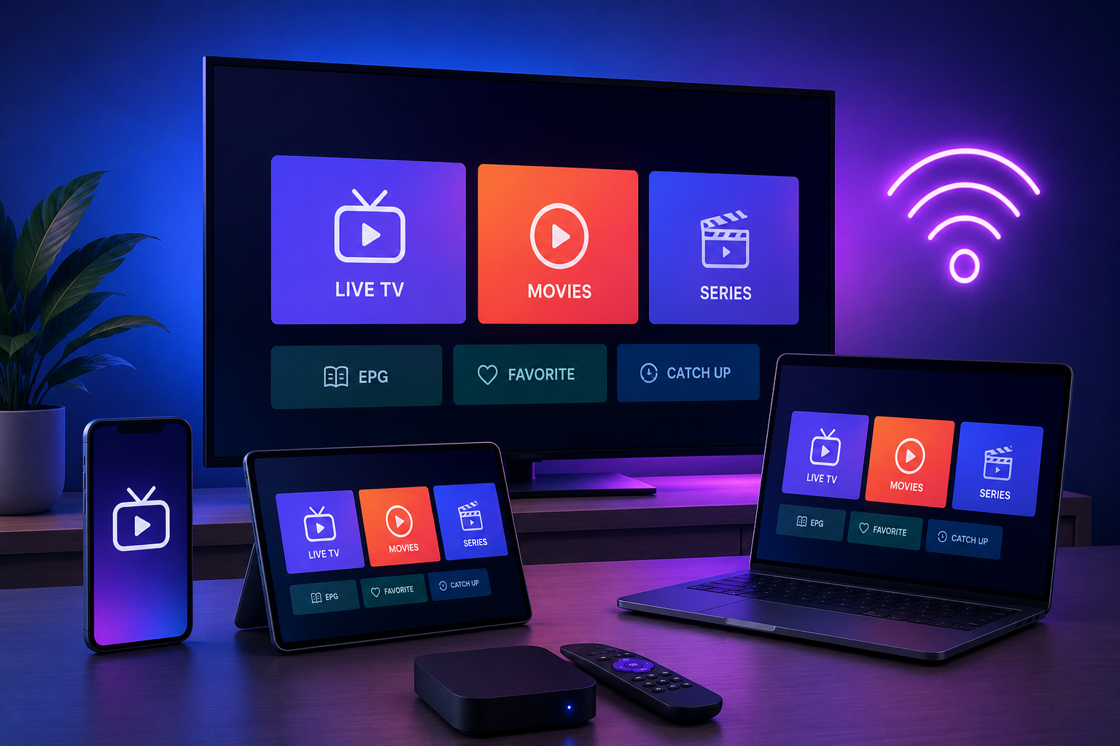
View the how does iptv work Platform →The third image below visualizes the three core IPTV delivery types side by side. This can help you understand what you are actually paying for when a provider says “full IPTV” — it usually means live streams plus catch-up plus a VOD library.
Who Should Use IPTV?
IPTV is not ideal for everyone, but several groups get the most value from it.
Cord-cutters who already have fast internet and a streaming device can replace a cable subscription with IPTV for a fraction of the monthly cost. The transition is easiest if you already use apps like Netflix or Prime Video and understand basic app installation.
Sports enthusiasts often turn to IPTV because it aggregates regional sports networks, international league feeds, and pay-per-view events. If you are comparing the best IPTV service for live sports, your priorities should be server stability, channel availability, and whether the provider has a proven record during major events.
Expats and multilingual households benefit from international channel lineups that cable packages rarely carry. You can watch news, entertainment, and sports from your home country without a satellite dish pointed in a specific direction.
Frequent travelers like IPTV because a subscription can work on a phone or laptop in another city or country, provided your provider allows it and you have a good VPN. Traditional cable boxes are tied to a physical address.
Budget-conscious households appreciate the flat monthly pricing with no hidden broadcast fees, regional sports surcharges, or box rental charges. Just be aware that the lower price sometimes comes with lower reliability.
How to Get Started With IPTV: 7 Practical Steps
Follow these steps to avoid the most common mistakes. The setup process is similar whether you use a smart TV, Android box, or Firestick.
- Check your internet speed. You need at least 25 Mbps for reliable HD streams and 50 Mbps or more for 4K. Use a wired Ethernet connection for the most stable live TV experience. Wi-Fi can work, but walls and distance reduce quality.
- Research providers before you pay. Look for current user feedback, not just marketing claims. Recent iptv review reddit 2025 threads can be useful, but remember that service quality changes quickly. Ask about server locations, trial options, and supported devices before committing.
- Choose a compatible device. The easiest options are an Amazon Firestick, an Android TV box, or a smart TV with an app store. You can also use an iPhone, iPad, or Windows/Mac computer, but the viewing experience is usually better on a TV screen.
- Install an IPTV player or the provider’s app. Some providers have their own app you sideload. Others give you credentials to use in a third-party player like TiviMate, IPTV Smarters, or IBO Player. How to set up IPTV on Firestick usually means installing the Downloader app, entering the provider’s URL, and sideloading the APK, or downloading a player from the Amazon Appstore.
- Enter your subscription credentials. You typically receive either an M3U playlist URL or Xtream codes (server, username, password). Open your player, add a new playlist, paste the URL, or enter the codes, then wait for channels to load.
- Optimize your connection and fix buffering. If you see frozen screens or frequent buffering, start with an iptv buffering fix guide: restart your router, switch from Wi-Fi to Ethernet, close background apps, lower stream quality, change your DNS to Cloudflare or Google, and test a different server or CDN if the app allows it.
- Test with a short subscription first. Avoid paying for 12 months upfront. Start with a 24-hour trial or one-month plan. Watch during peak evening hours and during a live sports event to see how the provider performs under load.
After step 7, you have a reliable baseline. If the service works well for a month, you can consider a longer plan. If not, you have lost very little and can move on without being trapped in a contract.
Tips for Better IPTV Reliability
Even the best providers can have bad days. These practical habits reduce problems.
- Always use Ethernet for stationary boxes and smart TVs.
- Keep your player app updated to the latest version.
- Use a VPN if your ISP throttles streaming traffic or you want to bypass geo-restrictions — but choose a VPN with fast servers.
- Close unused apps on your streaming device to free up RAM and CPU.
- Choose a provider with multiple server locations and ask if they offer a CDN option.
- Set your player’s buffer size to a higher value if possible to smooth out network jitter.
The legal side also matters. Some IPTV services are fully licensed and operate transparently. Others are not. If a deal seems too good to be true — hundreds of premium channels for a few dollars — it probably is. In the US, unlicensed IPTV providers and sometimes their users can face legal consequences. Always choose a provider that clearly states it holds the rights to the content it offers.
Making a Practical Choice
IPTV is a genuinely useful way to watch live TV and on-demand content without the cost and hardware of traditional cable. The technology works by sending compressed video streams over your internet connection to a device that decodes them in real time. Once you understand that basic flow, the rest is about choosing a stable provider and a setup that fits your home network.
Do not chase the cheapest plan. Instead, look for a provider with responsive support, a trial period, and servers near your region. Test before you commit, use Ethernet when possible, and keep a VPN ready if you travel. Those habits will prevent most of the frustration people report with IPTV.
Frequently Asked Questions
Featured Streaming Selection:
Find Out More About how does iptv work →Affiliate Disclosure: Clicking this secure link verified by our network supports our team through standard partnership terms at zero extra cost to your invoice.
This article contains affiliate links. Our editorial analysis remains independent.