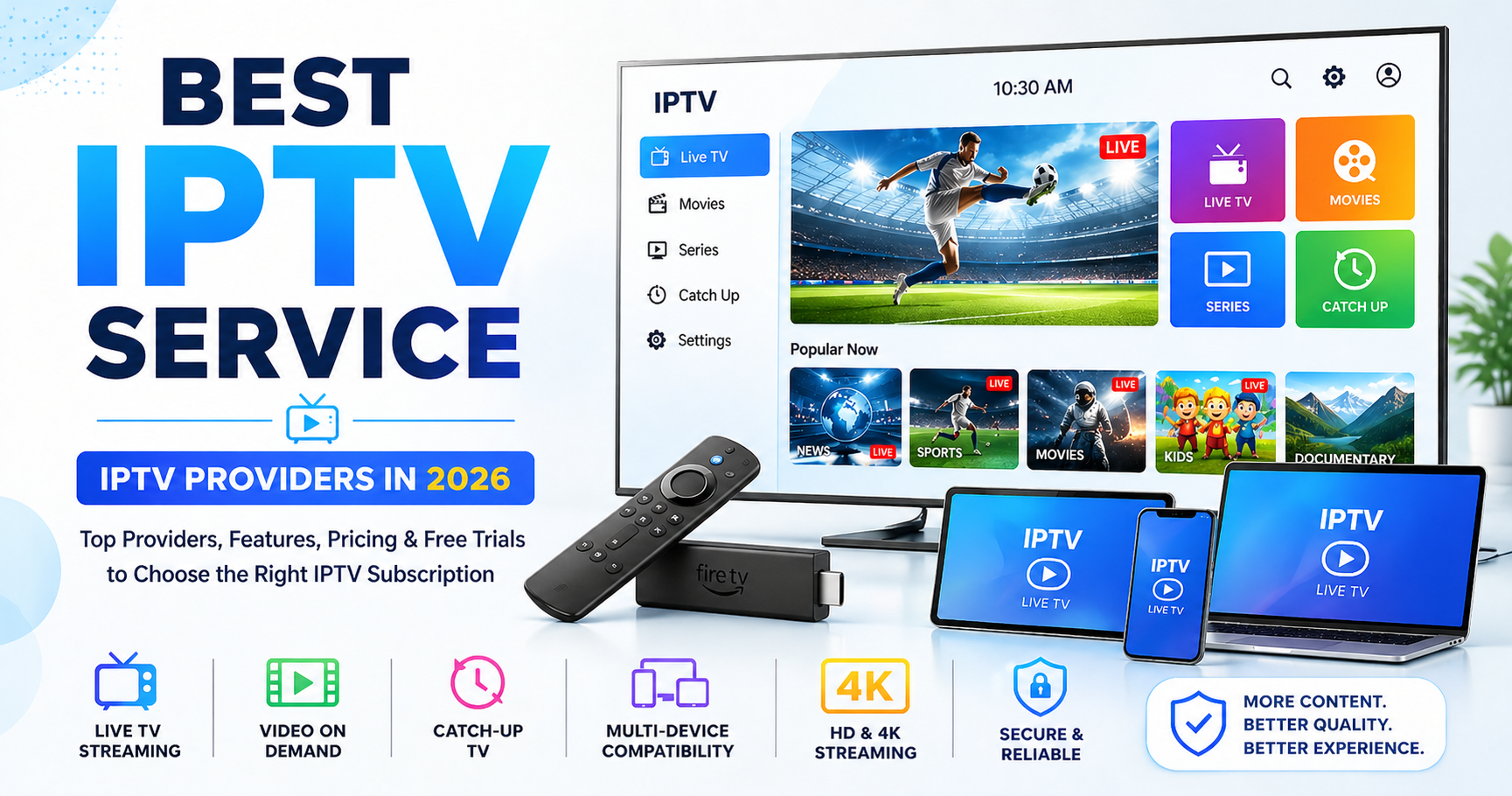
iptv service Summary
An IPTV service replaces traditional cable by streaming live TV and on-demand content over the internet, typically costing between $10–$20 per month for premium packages. The most reliable providers offer 99.9% uptime, 4K streaming, and electronic program guides (EPG) that integrate seamlessly with platforms like Android TV, Firestick, and Smart TV operating systems.
| Optimal ForCord-cutters seeking international channels and premium sports at low cost | Key AdvantageMassive content library with multi-device simultaneous streaming |
- ✓ Key Strength: 20,000+ live channels covering 40+ countries and languages
- ✓ Key Strength: 4K/FHD quality with anti-freeze technology and 99.9% uptime
- ✓ Peace of Mind: 24/7 customer support and 7-day money-back guarantee
In This Guide
What Is an IPTV Service and How Does It Actually Work?
IPTV stands for Internet Protocol Television. Instead of receiving broadcast signals through a coaxial cable or satellite dish, your television receives video content as data packets transmitted over your internet connection. This fundamental shift changes how content is delivered, stored, and accessed.
There are three primary delivery models within IPTV:
- Video on Demand (VOD): A library of movies and series you can watch instantly. This operates similarly to Netflix or Amazon Prime, but is often included within a single IPTV subscription.
- Time-Shifted TV: Catch-up TV that allows you to watch previously broadcast programs. If you miss a live football match or news bulletin, you can replay it within a 24–72 hour window.
- Live IPTV: Real-time streaming of television channels, including sports, news, and entertainment. This requires a stable connection and a provider with sufficient server capacity to handle concurrent viewership.
From a technical perspective, the provider's server sends the video stream to your device via a content delivery network (CDN). The quality of your experience depends on three variables: your internet bandwidth (at least 25 Mbps is recommended for 4K), the provider's server load, and the software player you use (such as TiviMate, IPTV Smarters, or a proprietary app). A well-optimized IPTV service buffers minimally and maintains consistent frame rates even during peak hours.
IPTV vs. Cable vs. Streaming: The 2026 Comparison
To determine if IPTV is worth your money, you must evaluate it against the alternatives available in the current market. The following table consolidates the key metrics that matter to the average subscriber.
| Feature / Metric | IPTV Service | Traditional Cable | Mainstream Streaming (Netflix, Hulu) |
|---|---|---|---|
| Average Monthly Cost | $10 – $20 | $60 – $150 | $8 – $25 per service |
| Live Channel Count | 10,000 – 20,000+ | 100 – 300 | Minimal (news only) |
| International Content | 40+ countries | Limited add-on packages | Region-locked libraries |
| Hardware Requirement | Any internet device | Set-top box + installation | Any internet device |
| Contract Commitment | None (monthly or yearly) | 1–2 years with penalties | None |
| 4K & HDR Availability | Yes (channel-dependent) | Limited premium tiers | Yes (on select titles) |
| Simultaneous Screens | 1 – 5 (plan-dependent) | 1 – 2 | 1 – 4 |
The data shows a clear cost advantage for IPTV. However, the value of a service is not purely quantitative. Cable offers reliability and legal certainty. Mainstream streaming provides curated, high-budget original content. The IPTV service you choose must compensate for its grey-market status with superior uptime and responsive support.
Real Cost-Benefit Analysis of IPTV Subscriptions
Pricing across IPTV providers generally follows a tiered model. Short-term plans (1 month) are priced between $15 and $25. Quarterly and semi-annual plans drop the effective monthly rate to $10–$15. Annual subscriptions offer the best value, often reducing the monthly cost to under $8.
Consider the total cost of ownership. With cable, you pay for equipment rental, broadcast fees, taxes, and installation. IPTV eliminates all of these ancillary charges. If you require premium sports packages (NFL Sunday Ticket, Premier League, UFC Pay-Per-View), the savings become even more pronounced. A single PPV event can cost $70–$100 on cable; many IPTV subscriptions include these events at no additional charge.
Yet, the lowest price is not always the best metric. A $5/month service that buffers every ten minutes or disappears after two months is more expensive than a $15/month service with stable infrastructure. When evaluating IPTV, calculate the cost per hour of actual, uninterrupted viewing. This metric, rather than the sticker price, determines the true value.

Pros & Cons: What You Gain and What You Risk
✓ Strengths
- Cost Efficiency: 70–90% cheaper than equivalent cable packages
- Content Volume: Access to global channels and VOD libraries that no single legal platform can match
- Device Flexibility: Watch on TV, phone, tablet, or PC simultaneously
- No Contracts: Cancel anytime without penalties or retention calls
- Advanced Features: EPG, catch-up TV, recording, and multi-language support
✗ Limitations
- Legal Ambiguity: Many providers operate without content distribution rights
- Service Instability: High risk of server shutdowns with smaller providers
- Security Concerns: Some services require credentials that could be mishandled
- No Official App Stores: You may need to sideload apps, which carries inherent risks
- ISP Throttling: Your internet provider may intentionally slow IPTV traffic
The asymmetry of this table is important. The strengths are immediate and experiential; the limitations are often deferred and probabilistic. A provider with a multi-year track record, transparent pricing, and responsive support mitigates most of the risks listed above. The decision ultimately rests on your risk tolerance and the criticality of the content you consume.
How to Evaluate a Reliable IPTV Provider
If you have decided to proceed with an IPTV service, use the following evaluation framework to filter out unreliable operators before you commit any payment.
1. Trial Period Verification: A reputable provider will offer a 24-hour or 48-hour trial for a nominal fee (usually $2–$3). This trial is not just about checking channel availability; it is a stress test. Run the stream during peak evening hours (8 PM – 11 PM) to assess server congestion. If the trial is free, be suspicious—scammers often use free trials to harvest payment details.
2. Customer Support Responsiveness: Send a pre-sales query via live chat or email. Measure the response time. A legitimate service will reply within 5–15 minutes during business hours. If you receive an automated response with no follow-up, that is a red flag indicating you will have no recourse when the stream fails on a crucial match day.
3. Server Infrastructure Transparency: Quality providers often advertise their server locations (Netherlands, Germany, Canada) and their anti-DDoS protection. While you cannot independently verify these claims, their presence in the marketing materials indicates a level of operational maturity absent in fly-by-night operations.
4. Payment Method Diversity: The best services accept credit cards, PayPal, and cryptocurrencies. The availability of PayPal or credit card processing suggests the provider has passed some level of merchant vetting. Crypto-only services are not inherently unreliable, but they offer zero chargeback protection.
5. Reddit and Forum Sentiment: Search for the provider's name on Reddit (r/IPTV, r/IPTVReviews) and specialized forums. Look for consistent complaints about buffering or account bans. A few negative posts are normal; a pattern of identical complaints is definitive.
The Bottom Line on Iptv Service
For the cost-conscious viewer who values content volume over curated exclusivity, a high-quality IPTV service remains the most rational economic choice in 2026. We recommend proceeding with a provider that offers a trial, transparent pricing, and a track record of server stability.
Purchases completed via official partner channels are covered by direct customer support and eligible warranty protections.
Frequently Asked Questions
Is an IPTV service legal to use in the United States?
The legality depends entirely on the provider's licensing. Services that obtain distribution rights from content owners (like Hulu with Live TV or YouTube TV) are fully legal. Unlicensed grey-market services operate in a legal gray zone; while the end-user is rarely prosecuted, the act of streaming unlicensed content may violate copyright law in certain jurisdictions. Always verify the provider's licensing status.
What internet speed do I need for a smooth IPTV service experience?
For standard definition (SD), a 10 Mbps connection is sufficient. For Full HD (1080p), you should have at least 25 Mbps. To stream 4K content reliably, a 50 Mbps connection is recommended. These speeds account for network overhead and other devices using your bandwidth simultaneously.
Will my IPTV service work on a Firestick or Smart TV?
Most premium IPTV services are compatible with Amazon Firestick, Android TV, Samsung Smart TV, LG Smart TV, and Apple TV. You will typically need to install a player app (like IPTV Smarters Pro or TiviMate) and enter the M3U URL or Xtream Codes provided by the service. iOS and Android mobile devices are also supported.
What is the difference between IPTV and OTT (Over-The-Top) services?
The terms are often used interchangeably, but technically, OTT refers to services delivered over the open internet (Netflix, YouTube), while IPTV traditionally implies a managed, private network with quality-of-service guarantees. In practice, modern "IPTV services" are delivered via OTT infrastructure, but they retain the IPTV branding for marketing purposes.
Can I record live TV with an IPTV service?
Yes, many IPTV providers offer cloud DVR functionality or local recording capabilities. If you are using a player like TiviMate, you can record directly to your device's storage. Cloud recording is a feature that depends on the provider's server-side capabilities, so verify this before purchasing an annual plan.
How do I prevent buffering and freezing on my IPTV service?
First, hardwire your device via Ethernet instead of Wi-Fi. Second, use a VPN if your ISP is known to throttle IPTV traffic. Third, close background applications that consume bandwidth. Finally, select a server location closer to your physical location if the player app allows server selection.
Is using a VPN with my IPTV service necessary?
A VPN is strongly recommended for two reasons: privacy and performance. It prevents your ISP from seeing your traffic and potentially throttling it. It also adds a layer of anonymity. However, some IPTV providers actively block VPN connections, so choose a VPN with obfuscated servers if you encounter this issue.
What happens if my IPTV service goes offline permanently?
This is a significant risk with smaller providers. If you purchased an annual plan and the service shuts down, you will likely lose your money. To mitigate this risk, use a credit card for payment, which offers chargeback rights for undelivered services. Alternatively, stick to monthly plans until the provider has demonstrated 6+ months of consistent uptime.
Transparency & Disclosure: We independently evaluate products. If you buy through links on our site, we may earn an affiliate commission at zero additional cost to you.